United Chemical
Login
$0.00 0

Cart

No products in the cart.

Continue shopping

EPA vs Sodium Bromide: The Real Story Part 1 & 2

If you’ve been paying attention to the swimming pool industry lately, you know that a single line on a product label can shake up the entire trade. Specifically, the EPA’s recent interim decision regarding Sodium Bromide—adding the phrase “not for use in outdoor pools”—has left many pool professionals and homeowners searching for answers. To clear […]

Article in brief:
  • The EPA’s recent interim decision restricting Sodium Bromide in outdoor pools is based on worst-case lab scenarios rather than real-world pool conditions.
  • Scientific research shows that trace bromate formation is far less alarming in practice, as human stomach acid naturally reduces it back into harmless bromide.
  • Many reliable pool products are dropping "kills algae" claims simply to avoid the heavy fees and compliance burdens of strict EPA pesticide registrations.

Table Of Contents

If you’ve been paying attention to the swimming pool industry lately, you know that a single line on a product label can shake up the entire trade. Specifically, the EPA’s recent interim decision regarding Sodium Bromide—adding the phrase “not for use in outdoor pools”—has left many pool professionals and homeowners searching for answers.

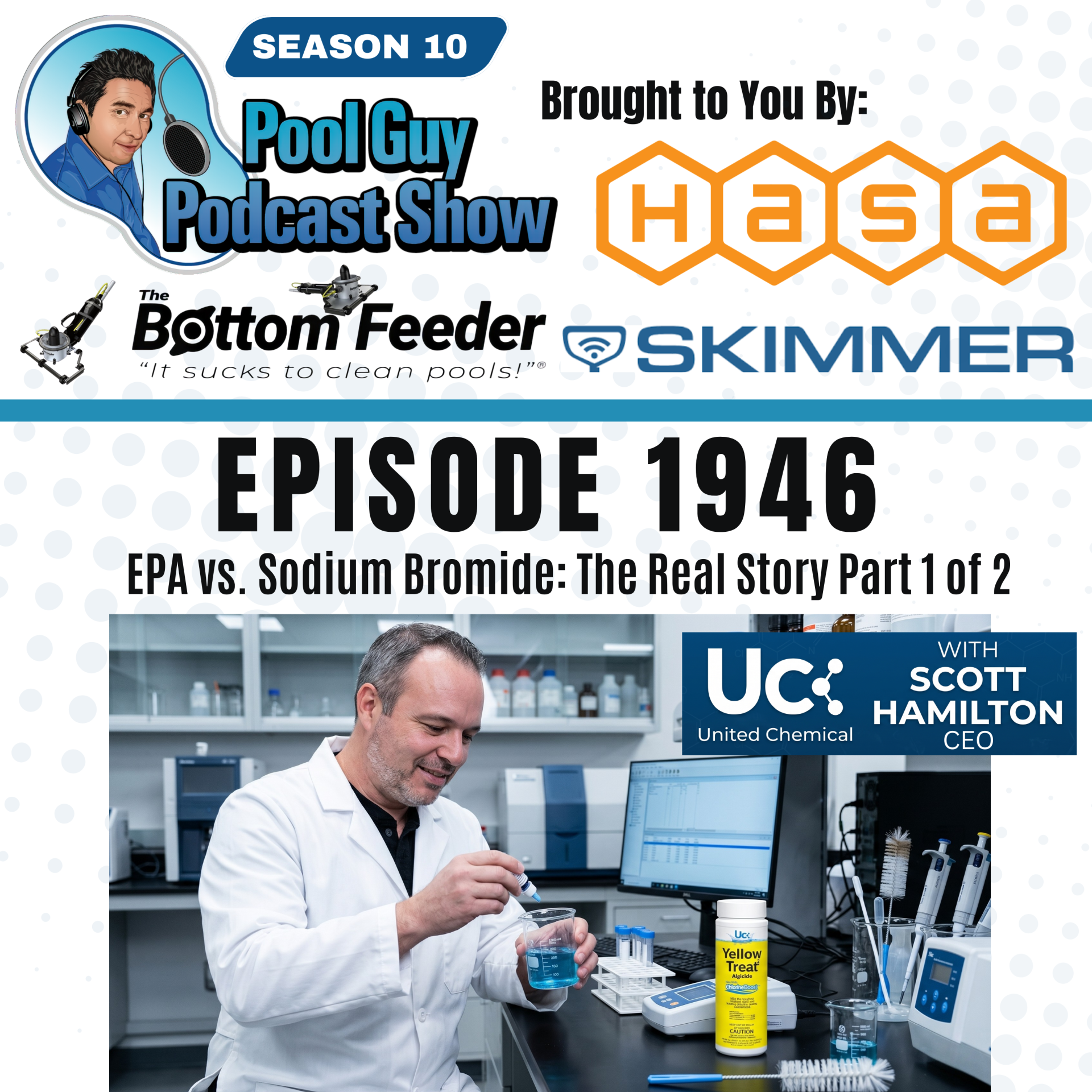
To clear the air, Scott Hamilton, CEO of United Chemical, recently sat down with David Van Brunt on The Pool Guy Podcast Show (Episodes 1946 and 1947) to discuss the science, the regulations, and what this actually means for the future of pool care.

Real-World Data vs. Worst-Case Assumptions
One of the most eye-opening takeaways from Hamilton’s interview is how the EPA conducts its testing. The regulatory protocols often stress pool chemistry using worst-case scenarios: high pH, zero cyanuric acid (CYA), and heavy liquid chlorine dosing in above-ground pools. While safety is paramount, these linear risk assumptions often don’t mirror real-world pool usage or actual field-relevant data.

Hamilton dives deep into the chemistry of bromate formation, highlighting how trace bromate reacts in practical situations—and fascinatingly, how research shows stomach acid can actually reduce a large portion of trace bromate back into harmless bromide.

The Business of “Algae-Kill” Claims
Why do some of the most reliable products in the industry suddenly drop their “kills algae” claims? As Hamilton explains, it rarely has to do with the formula’s effectiveness. Pesticidal claims trigger strict EPA registrations, state-by-state fees, and massive compliance burdens.

The Bottom Line on Pool Care Benefits
At the end of the day, United Chemical and industry leaders are dedicated to transparency and delivering premium, effective swimming pool products. Understanding the chemistry of your pool helps you tackle algae outbreaks efficiently and safely.

If you want to hear the full story, we highly recommend downloading Episodes 1946 and 1947 of The Pool Guy Podcast Show. Armed with the right knowledge and the right chemical solutions, you can keep your pool crystal clear all season long.

About the Author

Scott Hamilton
Scott Hamilton, CEO of United Chemical, is a second-generation pool chemistry expert. Trained by founder Jock Hamilton, Scott combines decades of industry experience with a passion for pool water education, ensuring United Chemical remains the trusted leader in innovative water care.

Related Posts

Navigating the EPA’s Sodium Bromide Decision: Scott Hamilton on the Talking Pools Podcast

If you are a pool professional, you already know that staying ahead of industry regulations and chemical standards is crucial to your business. Recently, the EPA’s Interim Decision on Sodium Bromide has sparked a lot of conversation—and a few questions—across the pool service ind...

Hard Data, Real Results: Why the “Worst-Case” for Bromate is Still Safe

For years, the pool industry has debated the safety of outdoor sodium bromide. We put the speculation to rest with hard data. Read our latest “worst-case scenario” study to see how our proprietary chemistry securely meets EPA safety margins, giving you total professio...

Is Sodium Bromide Banned? New EPA Regulations

Several customers have shared a rumor that the US EPA is “banning” Sodium Bromide. We would like to address this rumor directly. First and foremost, the U.S. EPA is not stopping the sale of sodium bromide products in the pool industry. The US EPA has decided to require sodium bro...

Sodium Bromide Algaecide: The Science of Killing Pool Algae

Is your pool turning green despite your best efforts? If you are fighting stubborn blooms—especially resistant strains like mustard algae—standard chlorine shock might not be enough. At United Chemical, we believe in solving problems with science, not guesswork. Many pool owners ...

Related How-Tos

How to Treat White Water Mold in Swimming Pools

Does your pool look like it was filled with shredded tissue paper? Then your pool has “white water mold”. Despite the name, this is actually a type of algae that is closely related to mustard algae. In this article we show you how to get rid of it fast so you can go b...

How to Kill Pink Algae in your swimming pool

Although uncommon, pink algae in your pool can create a real headache. This type of bacteria can grow quickly and hide in hard to reach areas. Not to mention that it can infect open sores and wounds. Here we’ll show you how to get rid of pink pool slime fast and keep it fro...

How to Get Rid of Black Algae in your Swimming Pool

Black algae is a type of bacteria that can be really tough to kill and control in your pool. Here we show you had to kill black algae fast and how to prevent it from coming back.

How to get rid of Mustard Algae in Swimming Pools

From Florida to California and everthing in between; Mustard Algae is the most common form of swimming pool algae. Odds are if you’ve owned a swimming pool, you’ve ran into this yellowish sandy looking algae growing in the shady areas of your pool. Here we give you st...

How to Clean a Green Swimming Pool Fast

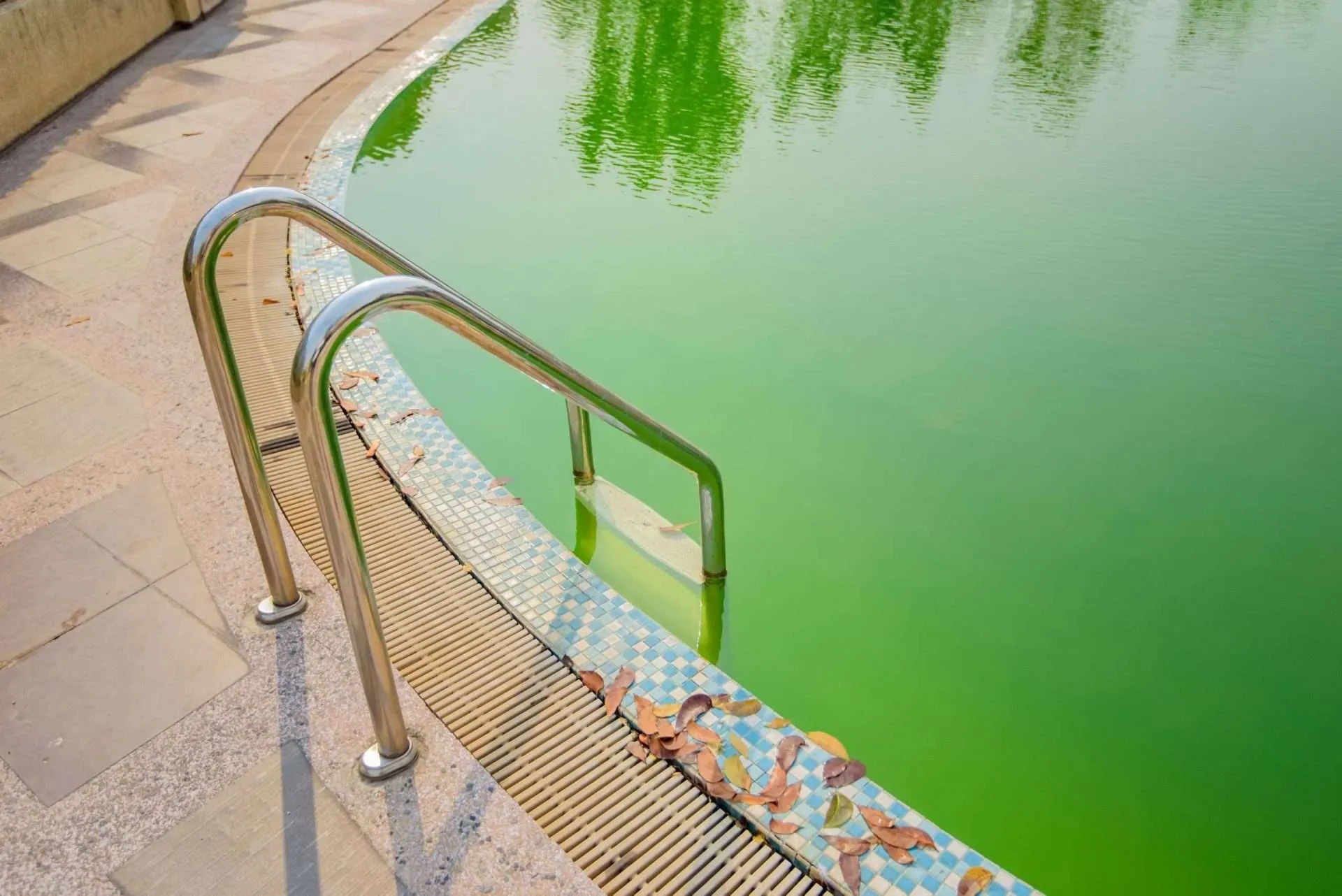
Every once and while, your pool will get away from you and turn into a total swamp filled with green algae. Maybe you had a bad storm. Maybe you went on vacation. No matter how it happened, we’ll show you how you can have your pool looking back to new in no time.

Related Guides

The Ultimate Guide to Pool Water Balancing: Chemistry, Care, and The Hamilton Index

Owning a pool should be about relaxation, not a daily struggle with test kits and chemicals. Yet, many homeowners and pros alike find themselves trapped in a cycle of “yo-yo” chemistry—constantly adjusting pH down, only to watch it bounce back up days later. This guid...

The Ultimate Guide to Salt Water Pools: Chemistry, Care, and Reality

The widespread adoption of saltwater pools is one of the most significant technological shifts in modern aquatic facility management. This transition shifts the locus of chemical manufacturing from centralized industrial plants to the point of use, fundamentally altering the oper...

The Ultimate Guide to Pool Surfaces: The “Universal Solvent” & The Hamilton Advantage

When you look at a swimming pool, you see sparkling blue water and a place to relax. But as pool pros, we see a dynamic chemical battleground. Your pool’s surface isn’t just a waterproof wrapper; it is a living “immune system” that interacts with the water every...

The Ultimate Guide to Pool Filter Maintenance: Chemistry, Cleaning, and Efficiency

The modern swimming pool is a complex hydraulic system, but if the pump is the muscle, the filtration unit is the “Hydraulic Heart.” While sanitation systems (like chlorine or salt generators) are responsible for killing pathogens, the filter is tasked with the physic...

The Ultimate Guide to Pool Algae: Identification, Biology, and Behavior

To the naked eye, a swimming pool is a simple vessel of water. But biologically, it is a fragile ecosystem constantly under siege. While you view your pool as a place to relax, nature views it as a perfect niche: warm, wet, and rich in nutrients. When water turns cloudy or spots ...

Comments

    Leave a Reply

    Your email address will not be published. Required fields are marked *

    Your Partner in Perfect Water (And Savings)

    At United Chemical, we believe what we do helps make people happy. Join our community to receive expert pool care education, helpful tips, and exclusive product updates. As a welcome gift, we’ll send you a code for 10% off. Let us help you succeed in keeping your pool crystal clear.
    United Chemical
    (800)524-5550
    Mailing:
    P.O. Box 429
    Piru CA 93040
    Shipping:
    3741 E. Telegraph Rd.
    Fillmore CA 93015

    Our Guarantee

    All United Chemical products are backed by a 100% Performance Guarantee: if a product doesn't do what it says it will then we'll fix it for free and/or give you a full refund.
    ©2026 United Chemical Corporation. All rights reserved.